
Indiana Students Still Believe in Education. Too Many Can’t Enroll. What the Data Means and How Our Community Can Help.
By Janeen Butler, CICF Director of Scholarship Programs
Too many Hoosier students who want education after high school are not enrolling, and that has real consequences for Central Indiana’s workforce, families, and long-term prosperity. The data points to where the biggest drop-offs are happening and what barriers students are navigating.
Central Indiana Community Foundation sees these dynamics up close through scholarship funds established by generous community members, and through our partnership with Hamilton County Community Foundation, the Indianapolis Foundation, and Women’s Foundation of Indiana. In 2024, the combined scholarship program of our four entities awarded more than $2 million through 211 awards to 163 recipients, from 1,047 applications; within that total, CICF fundholders awarded 76 scholarships totaling $879,400.
Taken together, these trends clarify where Central Indiana can focus next, from scholarship design to employer support and community partnerships that help more students follow through on their plans.
An Enrollment Crisis
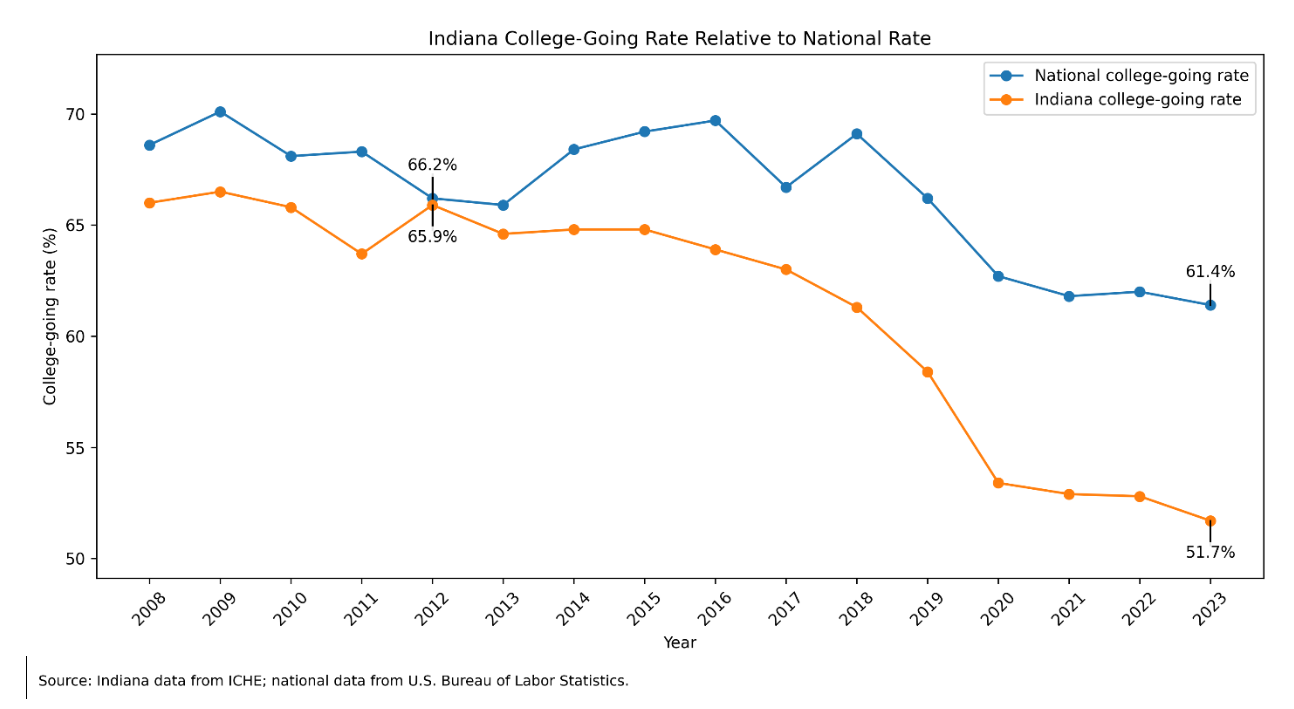
Last year’s annual report from the Indiana Commission for Higher Education showed bad news for Indiana’s educational attainment: After hovering at 53% for three years, Indiana’s college-going rate dropped to a low of 51.7%; that compared to a national enrollment rate of 61.4% in the same year (U.S. Bureau of Labor Statistics).
Not only was this the lowest rate for Hoosiers since at least 2008, but it was also our largest enrollment deficit with the nation. With few exceptions, this deficit has worsened consistently since 2012, a year when Indiana’s college-going rate was near parity with the U.S.
Why the Decline?
The overwhelming reason Hoosier students and families cite for bypassing college is (and has long been) cost. And while survey results from ICHE suggest many students and parents tend to overestimate that cost, there’s no disputing that a 4-year degree is far less affordable for a high school graduate than it used to be.
Since 1980, college costs and young-adult wages have gone in opposite directions: The average cost of a four-year public university degree increased 150% while minimum wage fell 35% (adjusted for 2022 dollars).
However, money is likely just a part of the larger explanation for Indiana’s unique declines in post-secondary enrollment. After all, leading up to 2023, many of the state’s largest universities showed an inflation-adjusted decline in annual tuition and fees.
Ball State economist Michael Hicks offers an alternative explanation, arguing that Indiana’s largest public universities are reducing effective aid to in-state applicants in a shift toward affluent and/or out-of-state students who pay more in unaided, direct tuition.
Whatever the reason for the decline, ICHE’s survey of high school seniors and their families showed that “80 percent of Hoosier high school students and parents believe continuing education beyond high school is worth the investment in their future [emphases added].”
In other words, an overwhelming majority of Hoosiers trust in the overall benefit of a post-secondary degree or credential. But if 80% acknowledge the value, and only 51% are finding a path to enroll, that means almost 30% are unable to realize their ambitions.
What’s the Big Deal?
Even if overwhelming majorities of Hoosier students are convinced of the benefits, it is still important to address a very basic question: Why is post-secondary education so important?
In an age of growing skepticism about the value of college, providing a thoughtful response can motivate more Indiana stakeholders to take action, including lawmakers, business leaders, and philanthropists.
Here’s the short answer: Generally, post-secondary education increases individual health and wealth, which in turn benefits local communities and economies.
It also meets a clear demand in the labor market. Across industries, employers increasingly need workers with education and training beyond high school, whether that means a four-year degree, an associate degree, a certification, an apprenticeship or another high-quality credential. Expanding access to those pathways helps more Hoosiers pursue stable careers while also helping employers fill critical roles, strengthen local businesses, and keep Central Indiana competitive.
But what’s the evidence?
For the individual, research compiled by Michael Hicks shows that each year of education completed after age 16 increases adult wages by about 15%.
Furthermore, while a post-secondary degree may not fully eliminate the adverse effects of childhood poverty, studies show that it substantially reduces them while greatly increasing the likelihood that one’s own children will attend college. That provides a generational boost for upward mobility, a metric Indiana has long struggled to improve.
But the benefits go far beyond individual degree-earners. A compendium of studies and reports assembled by Lumina Foundation demonstrated that post-secondary degree recipients are often physically healthier; live longer lives; are likelier to vote, volunteer, and participate in civic or religious organizations; and are less likely to commit crime.
Rising Scores Lift All Boats
Given what’s at stake, now is a great time for anyone concerned about the future of Indiana’s prosperity to invest in a robust post-secondary enrollment effort.
Yes, there are the obvious benefits, both individually and collectively, cited above. However, there are two timely reasons we should act:
- Indiana’s standardized test scores are rebounding to pre-pandemic levels,
- More seniors are graduating from Indiana high schools than ever before.
IREAD results for the 2024-25 school year had statewide reading proficiency over 87% – a five-point increase over the prior year. At IPS, there was a full 10-point gain year-over-year! And in Spring 2025, nearly 92% of Indiana’s high school seniors graduated, setting a new state record.
Those graduates and their younger siblings will be in a position to help reverse the decline in our state’s educational attainment. But Hoosier leaders in the public, private, and non-profit sectors must find ways to ensure that every high schooler who wants to can afford and access a post-secondary education – for their benefit and ours.
At Central Indiana Community Foundation, we believe one practical way our community can respond is by investing in scholarships that make education and training more accessible. If you’re interested in starting or adding to a scholarship fund, we invite you to learn more about how scholarship funds work and to explore our annual Scholarship Impact Reports to see what this giving makes possible.

Continue the Conversation: Email the Author
We’d love to hear your questions, ideas, and feedback. Use the form below to send a message to the author, ask a follow-up question, or share what resonated with you.